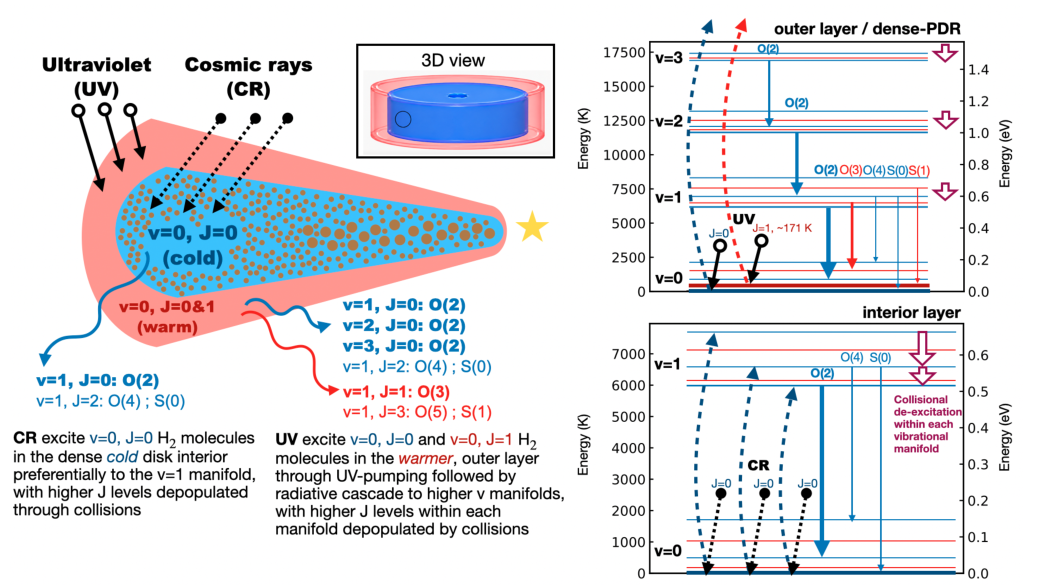
COSMIC RAYS IN DISKS
A novel method to detect cosmic-rays in disks
Using molecular hydrogen emission to investigate nonthermal excitation and ionization in planet-forming disks.
Explore the science ↗JWST · STAR & PLANET FORMATION
I study how stars and planets form, exploring the physical processes that shape their evolution and the chemistry that gives rise to the building blocks of planetary systems.
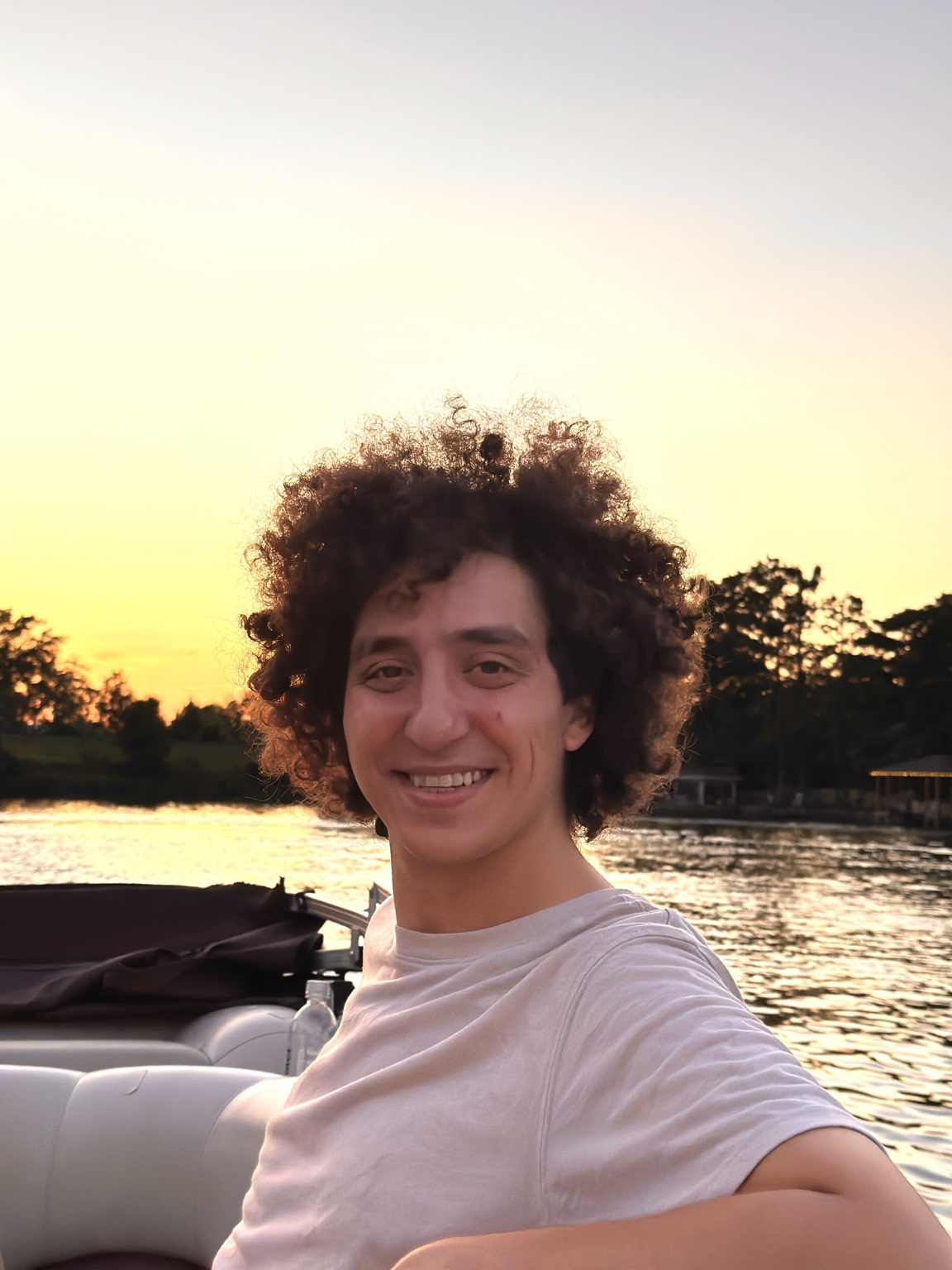
ABOUT ME
I'm a postdoctoral researcher at the University of Bern, where I work with Maria Drozdovskaya to study the chemistry of star- and planet-forming environments.
My research is broadly focused on understanding how stars and planets form, and the physical and chemical processes that shape their evolution. Much of my work involves using observations from the James Webb Space Telescope (JWST) to investigate molecular gas, protostellar jets and outflows, and the dust surrounding young stars. I'm particularly interested in how these observations can help us understand the environments in which planets form and the origins of the chemical material they inherit.
I completed my PhD in Astronomy at the University of Virginia, where I worked with Zhi-Yun Li studying the earliest stages of star formation. My research combines astronomical observations with physical modeling, and I enjoy finding new ways to use observations to investigate questions that have traditionally been difficult to address.
Beyond research, teaching and mentorship are important parts of my academic life. I enjoy sharing my interest in astronomy and helping others develop their own understanding of science. Outside of astronomy, I enjoy making music, gardening, and spending time with my family.
Get in touch ↗A CLOSER LOOK
COSMIC RAYS IN DISKS
Using molecular hydrogen emission to investigate nonthermal excitation and ionization in planet-forming disks.
Explore the science ↗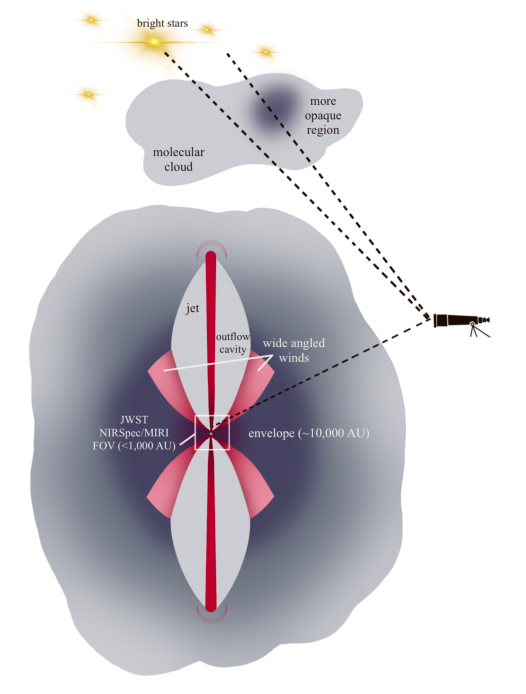
DUST & EXTINCTION
Embedded jets provide a new way to measure how dust attenuates infrared light in the material surrounding young stars.
Explore the science ↗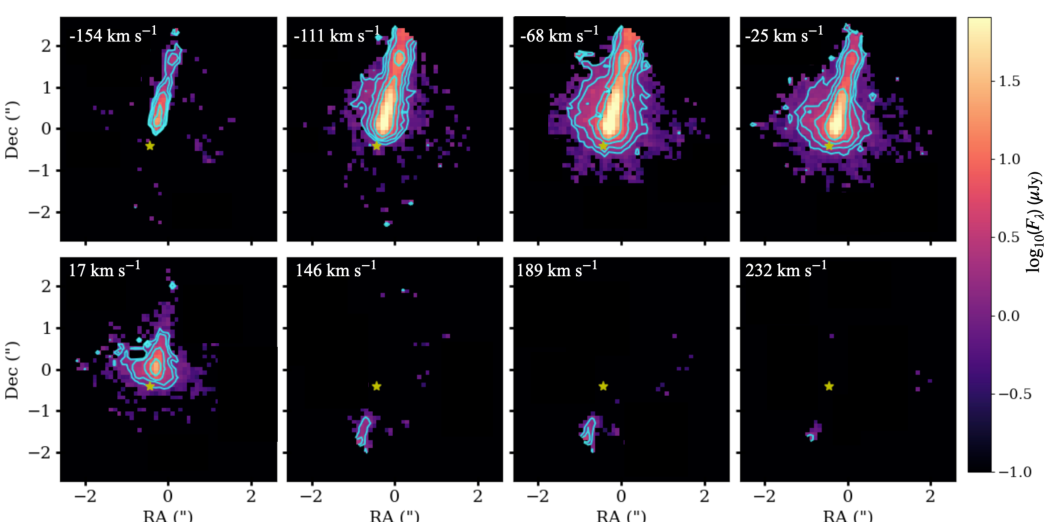
JETS & OUTFLOWS
Spatially resolved JWST spectroscopy reveals the asymmetric atomic jet and molecular outflow of TMC1A.
Explore the science ↗LET’S CONNECT